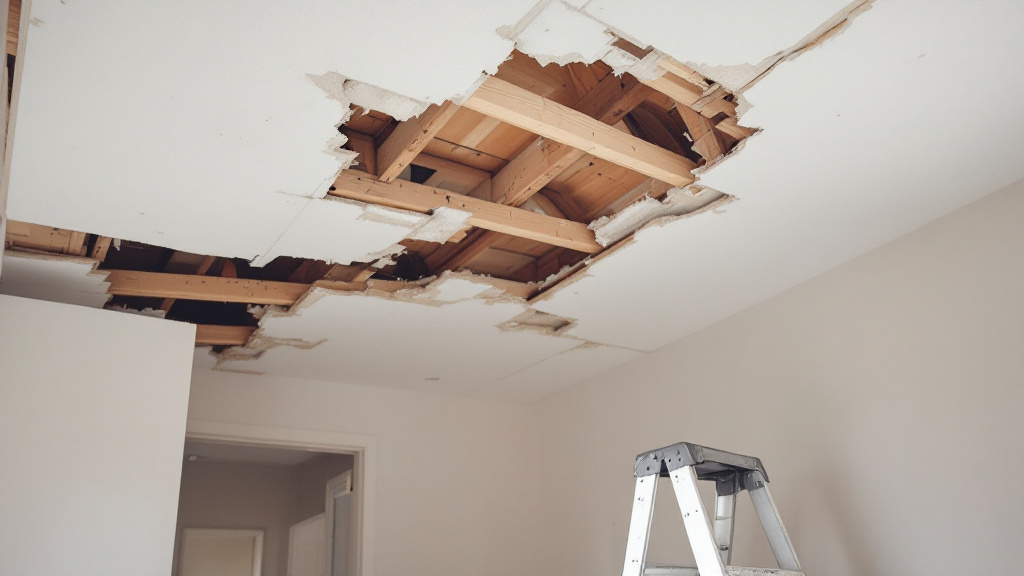
A ceiling rarely comes down without warning. Usually the plaster shows signs first: a sag between the joists, a crack that keeps getting longer, a brown stain that spreads after rain. The trick is knowing which of those signs can wait for a quote and which mean you should keep people out of the room today.
Here’s how to read the signs and what to do about them.
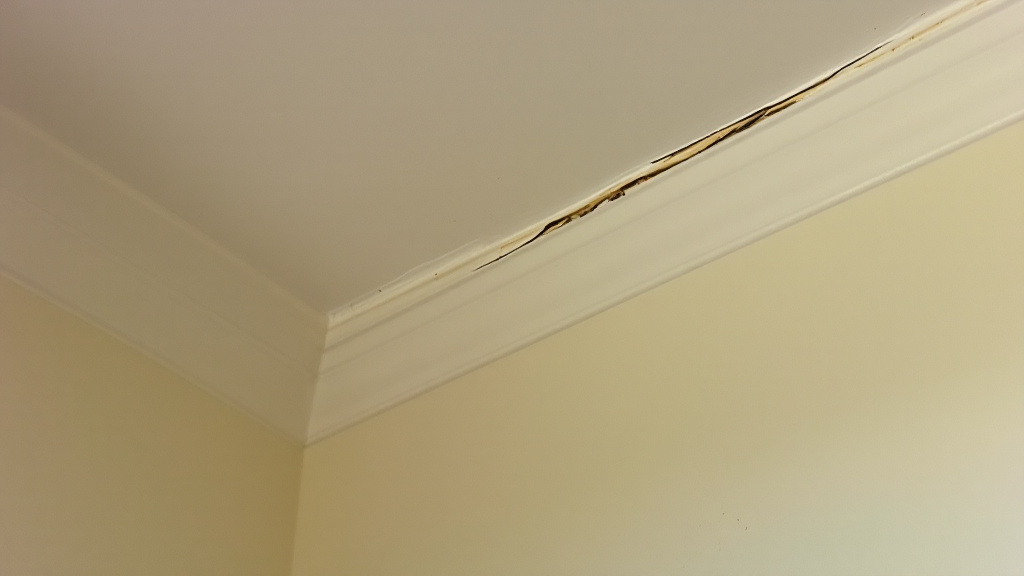
What causes a ceiling collapse?
Plasterboard ceilings are held up by fixings into the timber above them. Screws, nails and in older homes blobs of adhesive hold each sheet to the joists or battens. A ceiling collapse happens when enough of those fixings let go that the sheet can no longer carry its own weight.
The usual reasons are:
- Water: a roof leak, a burst pipe or an overflowing shower above soaks the board, and wet plaster is heavy and soft.
- Old adhesive: the glue used on older ceilings dries out and lets go, one blob at a time.
- Weight in the roof space: boxes stored straight on top of the ceiling, or someone stepping between the joists.
- Movement: timber that shrinks or shifts over the years pulls fixings loose along a run of sheets.
Often it’s two of these together. A ceiling with tired adhesive copes for years, then one wet week finishes it off.
Ceiling collapse warning signs to look for
Most warning signs show up well before anything falls. Walk through each room and look up with a torch held flat against the ceiling. Side light shows dips and bulges that are invisible in normal light.
Sagging plaster ceiling between joists
A gentle dip in the middle of a sheet, or a wave running across the room, is the most common early sign. It means the sheet has come away from the joists in that area. If you push lightly with a broom handle and it moves up and down, the fixings have let go. A sag that’s getting deeper week by week is urgent.
Cracks in the ceiling and cornice gaps
Straight cracks along a sheet joint are often just movement and can be patched. Watch for cracks that open wider, cracks that run in a curve around a dip, or a cornice that has pulled away from the ceiling along a whole wall. Those point to the sheet dropping rather than the paint cracking.
Water stains on the ceiling
A yellow or brown ring means water has been through the board. Even after it dries, the plaster in that patch is weaker than before. A stain that’s soft to touch, bulging or still damp is a sign the board above could fail. Find and fix the leak first, or the repair won’t last.
Popped screws in the ceiling
Small round bumps in a line across the ceiling are fixings pushing through the paint. A few on their own are common. Lots of them in one area, especially next to a sag, mean that area has moved.
Dust or cracking sounds from the ceiling
Fine white dust on the floor or furniture, with no work going on, can mean plaster is crumbling at a joint or fixing above. So can creaking or small cracking sounds from the ceiling, especially at night as the house cools. On their own they’re easy to miss. Next to a sag or a stain, they’re a sign to keep the room clear and get it checked soon.
What to do now if a ceiling collapse looks close
If the ceiling is bulging, dripping or moving, treat it as an emergency. Ceiling sheets are heavy, and a wet one is heavier.
- Get everyone, including pets, out of the room and close the door.
- Move furniture and anything valuable out from under the affected area if it’s safe to reach.
- If water is coming through, put a bucket under the drip but don’t stand under the bulge to do it.
- Stay clear of light fittings and ceiling fans that water has reached, and have an electrician check them.
- Don’t push the ceiling back up or poke a hole to drain it unless you know what the board is made of.
- Take photos of the stain, the sag and the room for your insurer before anything is moved or cleaned.
Then call a plasterer for a site visit. The ceiling should be checked from below and, where it’s safe, from the roof space above, so you know what has failed.
Ceiling collapse in older homes and asbestos
Before anyone cuts or breaks an older ceiling, find out what it’s made of. SafeWork NSW says homes built before the late 1980s may contain asbestos, and lists ceilings among the common places it was used. Asbestos sheeting can look a lot like plasterboard from below.
If your home is that age and the ceiling hasn’t been replaced, assume it could contain asbestos until it has been tested. SafeWork NSW strongly recommends a licensed professional takes any samples. Don’t sand, drill or break the board yourself. Leave the ceiling alone until you know what it’s made of.
How a ceiling collapse is repaired
The repair depends on how much of the ceiling has failed and why. A good repair starts by checking the fixings, the condition of the board and the cause.
Re-fixing a sagging ceiling
If the sheets are dry and whole, they can often be lifted back into place and fixed properly with screws into the joists. The joints and fixings are then set, sanded and painted. This only works when the board is still sound and the frame above is in good order.
Replacing ceiling sheets
When the plaster is water damaged, soft or broken, the affected sheets come out and new ones go in. The new sheets are matched to the existing ceiling, the joints are re-set and the cornice is replaced or reattached where needed. The ceiling is then painted so the repair doesn’t show.
Replacing the whole ceiling
If several rooms have the same failing adhesive, patching one sag at a time just moves the problem along. Replacing the ceiling in that room, or across the house, gives you new fixings everywhere. It’s also a chance to add insulation or change the cornice style while the ceiling is open.
What affects the cost of ceiling collapse repairs?
A ceiling repair is hard to price without seeing it. These are the things that change the price:
- Area: how many sheets have failed and how many rooms are involved.
- Cause: whether a leak still needs fixing before the plaster work can start.
- Access: ceiling height, stairs and how easy it is to get into the roof space.
- Board type: standard plasterboard, moisture resistant board for wet areas, or older material that needs testing first.
- Cornice and finish: matching an existing cornice profile and how much of the room needs repainting.
A free quote is the simplest way to find out. You’ll get a written scope that sets out what’s failed and what the repair includes. Our residential plastering page shows the other ceiling and wall work we do in homes.
When to call about a ceiling collapse risk
Call the same day if the ceiling is bulging, dripping, moving when pushed, or has a crack that’s opening up. Book a visit within the week if you’ve found a new stain, a sag you’re not sure about, or a run of popped screws. Even a small sag is worth a look before the wet season.
Contact us with photos of the ceiling, the room it’s in and roughly how old the house is. We’ll explain what we can see and the repair we’d recommend.
Plastering Central. Call 0459 664 951. NSW Licence 393197C (All Paintworx Pty Ltd).